
Lemhi Scheduled Versus Actual Release
“Projected release date” is common wording, but Idaho agencies use more exact terms. IDOC displays a Sentence Satisfaction Date, and its warning calls that type of value a scheduled termination date. The Commission may publish a tentative parole date after parole action. Neither is automatically the date a person walks out of a facility. The actual release entry is created after the custodian processes the event.
A pretrial detainee usually has no computed sentence date. Release may depend on bond, recognizance, dismissal, a court order, or the end of another hold. A court order authorizes action, but jail processing and an outside detainer can still affect physical exit. For a county sentence, ask the Lemhi County Jail and court for the applied calculation. For a felony commitment, use IDOC and the sentencing judgment.
Find a Lemhi Release Date
Begin with jurisdiction. The IDOC Resident/Client Search is appropriate for a state prisoner or person under state supervision, not for every county-only booking. Lemhi County publishes no online projected-date field. The jail and court record are the local sources.
- Confirm whether the person is at Lemhi County Jail, in IDOC custody, in the community, or with another agency.
- For IDOC, search by IDOC number when known. Otherwise use last and first name, then compare birth year, sentencing county, and case number.
- Open the detail record. Record exact status, physical location, Released to Supervision, Sentence Satisfaction Date, and data-current time.
- Check the sentencing judgment and later orders in Idaho iCourt. These establish fixed and indeterminate terms, credit, and amendments.
- For a county sentence, call Lemhi County Jail and request the jail calculation or release entry. Ask the clerk for the controlling judgment or order.
- For parole, read the Commission notice, then confirm that IDOC actually processed release.
A discharged IDOC summary may omit prior conviction detail by design. The court docket remains the durable case source. When the public data appears stale or conflicting, request the sentence calculation and status history through IDOC Records. The full Lemhi County release record process covers the county entry after the event.
Lemhi County Good-Conduct Dates
Idaho has no general rule that every prisoner serves a fixed percentage such as 85 percent. Under Idaho Code § 19-2513, the court sets a minimum period of confinement, often called the fixed term, and may add an indeterminate term. Ordinary parole, discharge, and good-conduct reduction do not cut the fixed state-prison term. Parole consideration begins in the indeterminate portion and remains discretionary.
IDOC Sentencing Records reviews judgments, applies jail and retained-jurisdiction credit, processes parole forfeiture, and coordinates with courts, jails, institutions, supervision offices, and the Commission. Concurrent or consecutive cases, amended judgments, and different kinds of credit make a home calculation unreliable. Obtain the agency calculation when a single day matters.
Lemhi Jail Date Calculation
The county rule is separate. Idaho Code § 20-621 provides five days off for each month for a county-sentenced person with a good record and orderly work performance, but the sheriff must recommend it and the magistrate judge must allow it. It is not an automatic online calculator. The jail and court files show whether the allowance was applied.
This county and state split is the key Lemhi release-date quirk. The county allowance cannot be carried over to shorten a state fixed term. Likewise, the state Sentence Satisfaction Date should not be used as a county jail exit date. Name the statute, custodian, and sentence type before using any date.
Why Lemhi Release Dates Change
A date can move because the legal sentence, applied credit, custody facts, or release plan changes. The field should be treated as a dated agency statement, not a promise. Preserve the label and the time viewed.
| Change | Effect to verify |
|---|---|
| Corrected jail credit | IDOC or the court recalculates the endpoint. |
| Amended judgment | A later court order changes the controlling terms. |
| Parole warrant or forfeiture | Time treatment and satisfaction can change. |
| New case or detainer | One authority may release while another keeps custody. |
| Program or plan approval | A tentative parole date may not become actual release. |
| Agency timing | The public screen may lag a processed event. |
A parole grant does not mean release on the day of the hearing. Required programs, residence, transportation, signed documents, and IDOC approval can remain. Conversely, parole can place a person in the community before the sentence satisfaction date. That is supervised release, not final discharge.
Confirm Lemhi Actual Release
Check close to the planned event with the actual custodian. For Lemhi County Jail, ask whether the event was community release or a transfer and request the processed date and time. For IDOC, compare status and physical location, then contact Records or the listed supervising district. A later release record is stronger than a schedule.
Idaho VINE can add a custody-change alert for a specific person, but the agency feed may lag and a release event may mean departure to another custodian. The VINELink Release Check explains enrollment and confirmation. After notice arrives, call the reporting jail or IDOC and preserve the exact event wording.
A county call should ask for three separate facts: the processed release time, the release disposition, and any receiving agency. A state check should likewise separate physical location, legal status, and sentence endpoint. If the response identifies another county, federal authority, or immigration custodian, move to that agency's system. Departure from Lemhi custody can be a transfer rather than community release.
The court docket supplies another essential check. Bond information, judgment, credit for time served, probation, commitment, sentence amendments, and later orders can explain why an earlier estimate changed. A signed release order still may precede jail processing, so pair the docket event with the custodian's entry. If remote court display is incomplete, request the specific order from the Lemhi District Court Clerk rather than assuming the record does not exist.
Keep a short audit trail for every inquiry. Record the name and identifiers used, agency, source address, date viewed, exact field label, and data-current time. Mark a Commission date as tentative and a satisfaction date as scheduled when that is how the agency describes it. Once release occurs, replace prediction with the actual processed entry while retaining the earlier record as a dated snapshot. This prevents later changes from looking like unexplained errors.
Lemhi Tentative Parole Dates
The Commission publishes Notices of Action Taken by hearing session. A notice may contain a tentative parole date, a denial, a pass to full term, deferment, revocation, or another action. It is not a name-search database, and a hearing listing alone does not establish an outcome.
The Commission decision hub shows the tentative-date warning and available notices.
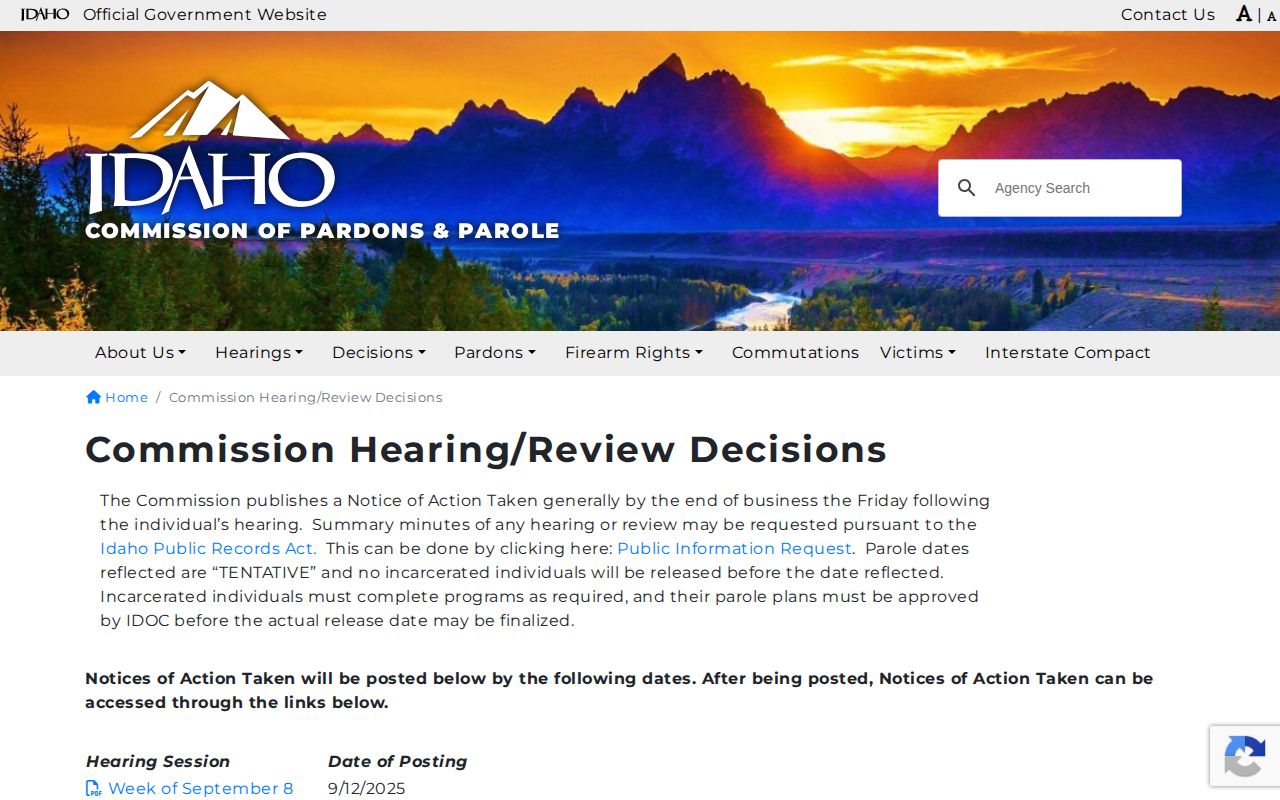
The captured source reinforces the distinction between a Commission action and release processed later by IDOC.
Eligibility also depends on sentence structure. Ordinary parole cannot occur during the fixed term, and a Commission grant remains discretionary once the indeterminate term begins. Read the judgment and action notice together. A denial, reconsideration, or pass to full term answers a different question from the satisfaction field and should be recorded in its own words.
Lemhi IDOC Sentence Fields
The public IDOC detail page can show offense, sentencing county, case number, sentence status, Released to Supervision, and Sentence Satisfaction Date. The overall record may also show status, physical location, supervising district, officer, and a correctional image. A person can be “In community” while the location line names a jail, so those fields must be read independently.
Identity checks matter before the date is used. Match an IDOC number when available, then confirm birth year, sentencing county, and case number. Partial-name searches return candidates, not a final match. Save the exact label rather than rewriting it as a projected date, since the label identifies what the agency actually calculated.
The official IDOC search form also states that its data can change rapidly.
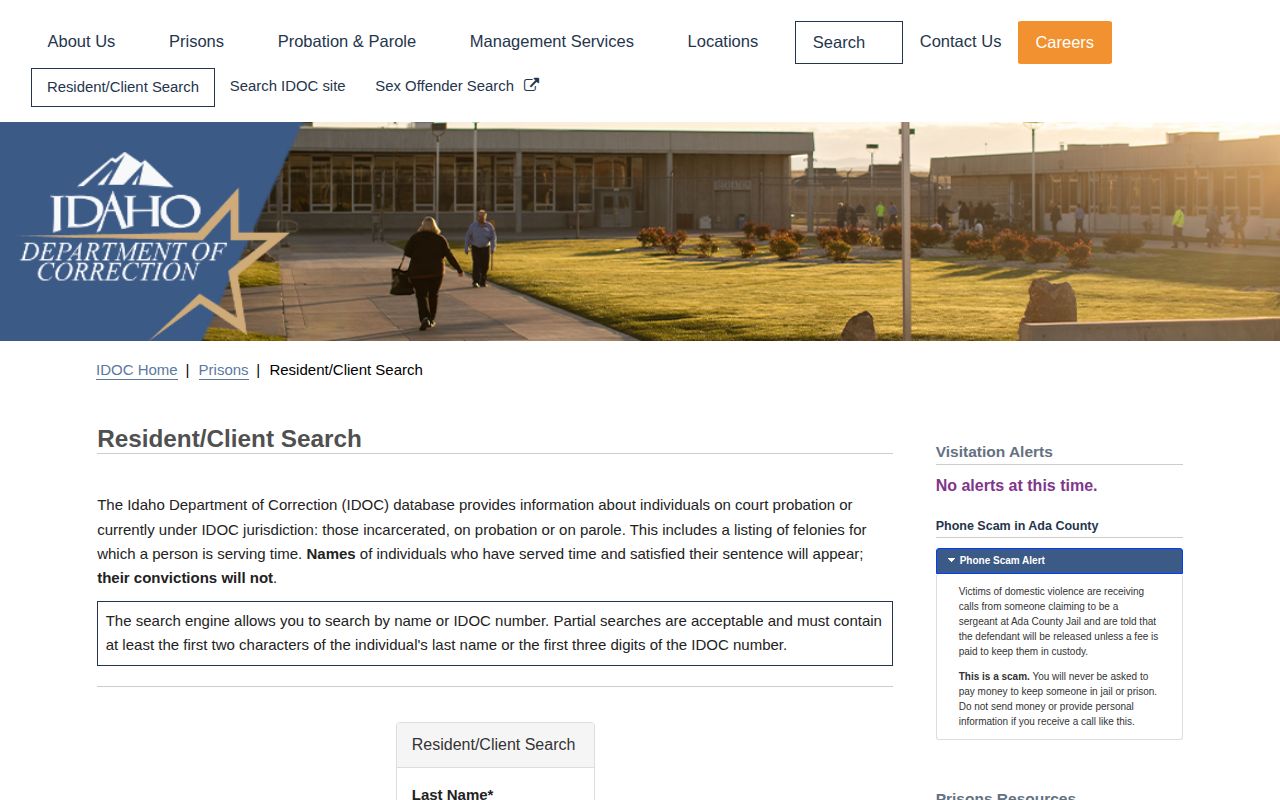
The warning is why a fresh agency confirmation belongs beside every saved date.
Note: A Sentence Satisfaction Date is a sentence endpoint field, not a label for the day a person left Lemhi County Jail.