
Lemhi County VINELink Coverage
Idaho VINE is the statewide custody-information and notification service sponsored through the Idaho Sheriffs' Association. The association describes interfaces with jail booking systems across Idaho, the Idaho Department of Correction, and an Idaho Supreme Court court-event component. That structure makes VINE a practical bridge for a reported Lemhi County Jail event and an IDOC event.
VINE is not the custodian's legal certificate. It displays data supplied through participating systems. A “released” event confirms departure from the reporting custody, but the label alone may not distinguish community release, parole, transfer, or another agency action. Call the reporting jail or IDOC after an alert. Ask what the event meant, when it was processed, and whether another custodian received the person.
Coverage stops at jurisdiction boundaries. VINE does not cover federal Bureau of Prisons custody. A county-only booking may never appear in IDOC. Conversely, an IDOC result cannot prove what occurred during a purely local Lemhi booking. The broader Lemhi County released inmate search routes county, state, federal, court, and immigration checks separately.
Search Lemhi County VINELink
Open the correct state portal and identify one person. A name alone can produce the wrong match. Compare available identifiers and the agency reporting the result before reading status details.
- Open Idaho VINELink or call 866-984-6343.
- Select or confirm Idaho, then enter the person's name or identification number.
- Add any filters and compare available identifiers. Do not join records merely because two people share a name.
- Open the correct result and read the custody status, agency or location, and reported event fields shown by the interface.
- If the result says released, contact the reporting jail or IDOC and ask whether the event was community release, parole, transfer, or another disposition.
Save the event time, source agency, and exact label. Interface labels may change. A screenshot or note records what appeared at that moment, not a fact that can never be corrected. If identity remains uncertain, keep the uncertainty rather than combining two records.
The manifest capture shows the official Idaho search entry point. Open the Idaho VINE source before viewing it.
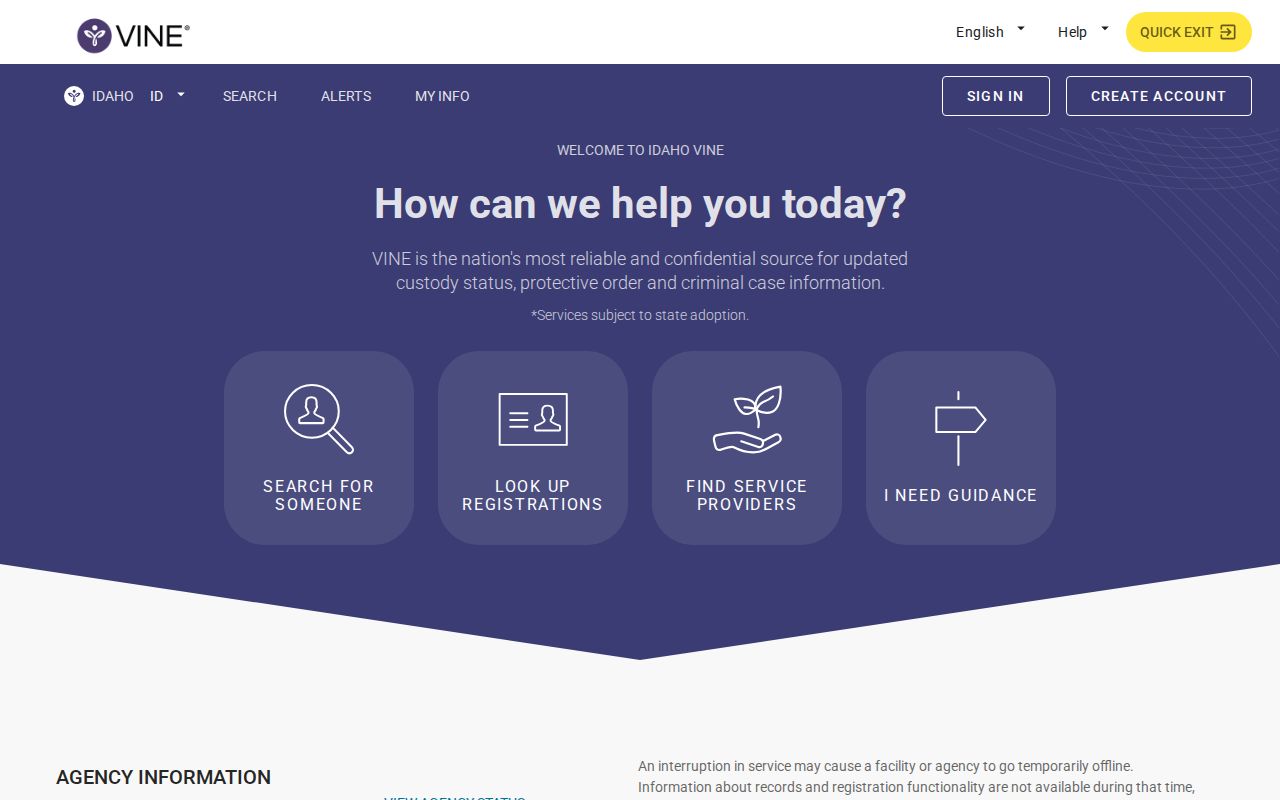
The search screen begins the match. It does not, by itself, prove a Lemhi County release or enroll a notification.
Lemhi VINELink Release Fields
The fields depend on the participating agency and current interface. Do not promise a release reason, exact time, photograph, or projected date unless the selected record actually displays it. Read the reporting agency with the status.
| Field | How to read it |
|---|---|
| Name or identifier | Use it to distinguish same-name results; compare another known fact where available. |
| Custody status | Describes the status supplied by the participant, not all possible custody systems. |
| Agency or location | Identifies the source to call and may show which custodian reported the event. |
| Event information | May describe release, transfer, escape, or another supported change. |
| Notification option | Allows enrollment through methods currently offered for that record. |
A released status is not final discharge. Parole can place a person in the community while an IDOC sentence remains active. Transfer can end Lemhi custody while confinement continues elsewhere. An IDOC Sentence Satisfaction Date is a scheduled sentence endpoint, not necessarily the date of prison exit. Preserve the system's exact words.
Register Lemhi County Release Alerts
Enroll only after selecting the correct person. Available methods can include telephone, text, email, web, or app options as presented. The interface determines which choices are active for a record.
- Select Get Notified or the notification option on the correct result.
- Choose an available method and enter the phone number or email address. Official Idaho instructions describe a plus control for another contact.
- For a telephone alert, create a memorable four-digit PIN. Do not share it.
- Complete the registration or confirmation step and retain the enrollment details.
- When a phone notice arrives, enter the PIN to acknowledge it and stop repeat calls. If the PIN is forgotten and calls must stop, contact VINE assistance.
Email generally does not use the telephone PIN. A successful enrollment means notice is requested; it does not guarantee that every data entry will be immediate or error free. Keep the reporting agency's direct contact available.
Confirm Lemhi VINELink Events
For a Lemhi jail event, call the non-emergency line at 208-756-8980 and ask for present status, actual event time, disposition, and any receiving agency. If a durable timestamp or type is needed, request the Sheriff's booking and release entry. Pair it with iCourt when the legal reason matters.
For state jurisdiction, check the IDOC Resident/Client Search. It can show status, location, supervision district, officer, sentence information, Released to Supervision, and Sentence Satisfaction Date on applicable records. IDOC warns that the database changes quickly even though it is updated daily.
If the jail reports federal movement, use the BOP locator only for BOP custody and release history. Federal pretrial custody may instead require the federal docket and actual holding jail. An immigration transfer calls for ICE channels. Do not interpret a VINE absence as proof that no custody event occurred.
Idaho VINE Jail Data
Idaho's local layer depends on the participating jail-management system. The Idaho Sheriffs' Association administers the service, while county jail and IDOC interfaces supply custody data. Idaho Jail Standard 05.16 addresses VINE processes, making accurate local data entry central to useful notice.
This explains why a family member can receive a valid alert yet still need the Lemhi jail record. VINE conveys the event from the system. The Sheriff remains the source for the maintained local release time and disposition. A correction or delay in the jail system can affect notification quality.
The Idaho Supreme Court event component adds court information to the broader service environment, but a court event is not the same as completed physical release. A signed order can precede jail processing or be subject to another hold.
Lemhi Release Status Terms
Several labels are easy to confuse. Read them as separate facts, then ask the responsible office to resolve any conflict.
- Release
- Departure from the reporting custodian; it may be to the community or another authority.
- Transfer
- Movement to a new custodian while confinement continues.
- Parole
- Supervised community placement after prison confinement during an eligible sentence phase.
- Probation
- A court-ordered community sentence supervised under the controlling order.
- Discharge
- The end of correctional sentence authority, not merely exit from a jail or prison.
An IDOC record can say “In community” while a location line points to a county jail after a new hold or violation. Status and physical location must be read independently. VINE adds an event, not a substitute for that two-part check.
Missed Lemhi Release Alerts
A missed or late alert does not settle the custody question. Confirm that the correct person and agency were selected, review the enrollment method, and call VINE assistance if a PIN or registration issue persists. Then contact the reporting agency directly.
For a past Lemhi County event, request the written jail entry. For a state event, ask IDOC Records for releasable status or discharge material. For the legal basis, check iCourt. These records remain the fallback when a dynamic alert is unavailable or no longer visible.
Preserve Lemhi VINE Events
When an alert arrives, record the time received, the event label, and the reporting agency. Then note the time the agency says it processed the underlying release or transfer. Those timestamps may differ because one describes agency action and the other describes delivery of a notice.
For a court-related event, keep the Lemhi case number and locate the matching public docket entry. For an IDOC event, keep the IDOC number and exact sentence-status wording. This simple source trail reduces same-name errors and makes a later records request precise. If a dynamic result changes, the maintained agency record can confirm what ultimately occurred.